
Take a Free MBTI Test with AI: The Ultimate Guide to the 16 Personality Types
July 31, 2024
Have you heard of the “MBTI test”? This fascinating test, also known as the 16-type personality test, uses a few simple questions to reveal which of 16 different personality types you are. It’s not just handy for job hunting or making friends; MBTI is also a go-to tool in many HR interviews, and it often shows up as a profile field on dating apps.
So how did such a seemingly simple test become so popular across so many areas of life?
It’s about more than just work and the workplace. Understanding MBTI personality types and how to get along with each one can help you navigate everyday life with ease. Whether you’re an introvert (I) or an extrovert (E), the MBTI test helps you understand yourself and others more deeply, making work and relationships easier and more enjoyable.
This post explains exactly what MBTI is, and also shares the latest ways to use AI to analyze your MBTI results and ask questions about them more accurately.
We strongly recommend reading to the end! But if you want to jump straight to using AI to analyze your MBTI results, you can try our top-recommended AI MBTI test right now: https://mixerbox.ai/@mixerboxai/ai_personalit
Contents
- The Origins and History of MBTI
- The Basic Principles of the MBTI Test
- How to Analyze Your MBTI Results with AI
- Where Can You Take the MBTI Test?
- Conclusion: Is MBTI Really Accurate?
The Origins and History of MBTI
MBTI, short for the “Myers-Briggs Type Indicator,” is a personality classification model.
MBTI was originally developed by American writer Katharine Cook Briggs and her daughter Isabel Briggs Myers. Driven by their passion for psychology, they built on psychologist Carl Jung’s 1921 book Psychological Types, researched it in depth, and published their consolidated framework in 1940.
Briggs and Myers believed the MBTI could help people understand themselves and make better choices at work and in life. Although not every psychologist endorses the MBTI, there’s no denying that it has become a highly influential personality assessment. It can strengthen self-awareness and help people find roles that suit them and reach their potential, and it also helps us understand how others behave and think.
7 Free AI Courses on Coursera (with Chinese Subtitles)
The Basic Principles of the MBTI Test
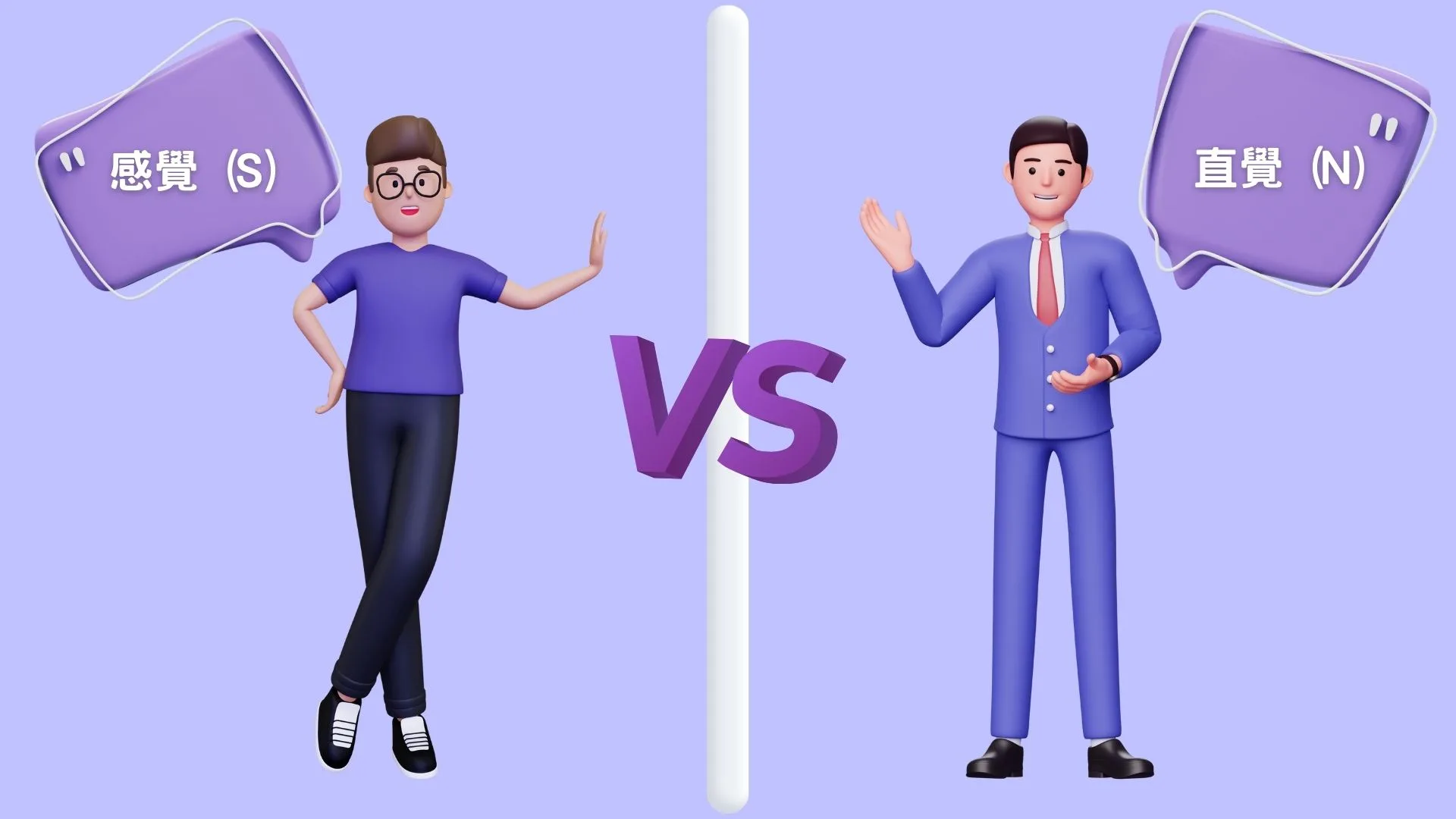
The MBTI is a personality test that reflects people’s preferences in attitudes and cognitive functions. It divides personality into four main dimensions: source of energy (Extraversion E vs. Introversion I), way of perceiving (Sensing S vs. Intuition N), basis for decisions (Thinking T vs. Feeling F) and approach to the outside world (Judging J vs. Perceiving P).
Different combinations of these four dimensions make up 16 distinct personality types, which is why the MBTI is also called the “16-type personality test.” Knowing each person’s MBTI type can help us better understand our own and other people’s behavior and ways of thinking.
The Four Dimensions of the MBTI Personality Test
The four dimensions of the MBTI test are:
Extraversion (E) vs. Introversion (I)
Extraversion: Gains energy from the outside world and interacting with people; prefers lively, varied environments.
Introversion: Gains energy from inner reflection and time alone; prefers quiet, stable environments.
Sensing (S) vs. Intuition (N)
Sensing: Focuses on concrete, real-world information; prefers to rely on the senses and experience to make decisions.
Intuition: Focuses on the future and abstract possibilities; prefers to rely on intuition and inspiration to make decisions.
Thinking (T) vs. Feeling (F)
Thinking: Focuses on logic and objective analysis; prefers to make decisions based on facts and reason.
Feeling: Focuses on personal values and emotions; prefers to make decisions based on feelings and relationships.
Judging (J) vs. Perceiving (P)
Judging: Likes a structured, planned life; prefers to make decisions and arrangements in advance.
Perceiving: Likes a flexible, spontaneous life; prefers to stay open and embrace new options.
Different combinations of these four dimensions make up 16 distinct personality types, each with its own way of thinking, behaving and relating to others. Understanding these dimensions not only helps us know ourselves better, but also helps us communicate and work with others more effectively.
How to Analyze Your MBTI Results with AI
Traditional MBTI testing requires the help of a professional psychologist, which takes time and effort and is prone to error. Meanwhile, popular free online tests often lack accuracy, and their results aren’t personalized enough; every analysis reads the same.
AI makes all of this much simpler. It can quickly analyze your answers and instantly generate a detailed report, saving you the high cost and the long wait.
How does AI make the MBTI test more accurate?
AI can tailor its analysis to your background and needs, so the results fit your actual situation more closely. Even better, if you have follow-up questions about your results, AI can understand what you’re asking and give you a relevant explanation.
For example, once you find out your type is “ENFP,” you can follow up with: “What jobs suit an ENFP?”
Or, if your crush is an “INTJ,” you can ask: “Are ENFP and INTJ a good match?”
Where Can You Take the MBTI Test?
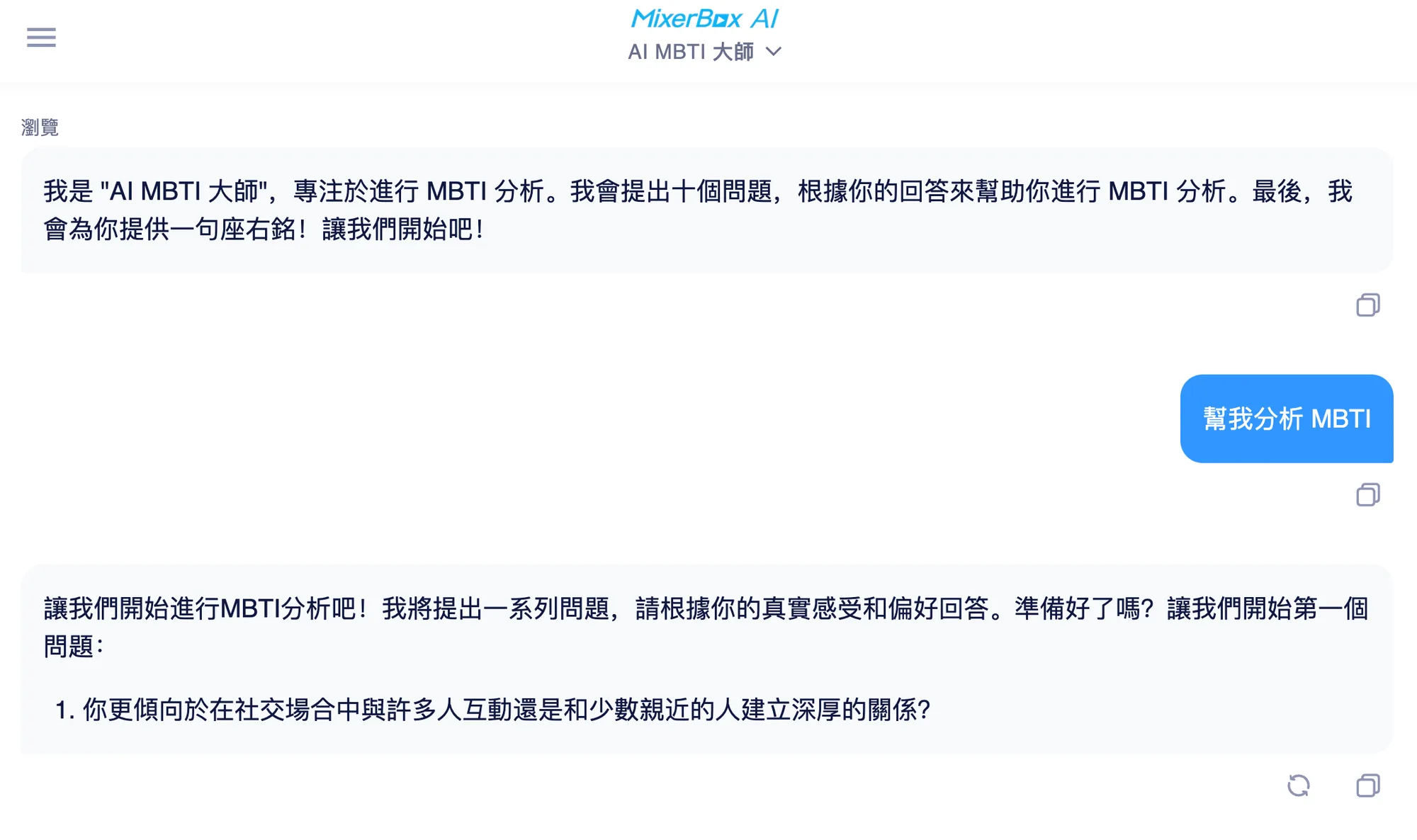
“AI MBTI Master” on MixerBox AI
If you want to take an MBTI test and ask questions about it with AI for free, we recommend “AI MBTI Master” on the MixerBox AI platform.
“AI MBTI Master” is a custom AI designed specifically for MBTI. Answer just ten questions and it gives you a first analysis of your MBTI type. Compared with traditional tests, AI MBTI Master automates the testing process and also provides in-depth personality analysis and practical advice.
But interactivity is AI MBTI Master’s most interesting strength. Built with generative AI technology, AI MBTI Master doesn’t just hand you a one-size-fits-all report; it can go on to answer any question you have about MBTI.
For example, once you find out your type is “ENFP,” you can follow up with: “What jobs suit an ENFP?”
Or, if your crush is an “INTJ,” you can ask: “Are ENFP and INTJ a good match?”
MBTIonline
Lots of websites offer MBTI tests, and the official assessment from MBTIonline is considered the most authoritative. The official test costs US$49.95, or about NT$1,500. After completing it, users receive a detailed personality report, plus a one-hour in-depth interpretation and coaching session with an MBTI expert.
Free Personality Test
Designed by the UK’s NERIS Analytics Limited, the “Free Personality Test” presents the 16 personality types as characters, with role names like Entrepreneur, Executive, Entertainer, Debater and Architect. These vivid, fun personality descriptions are widely loved and also make it easier for test takers to understand their results. Through these concrete, visual role names, users can grasp their personality traits and behavioral tendencies more intuitively.
Conclusion: Is MBTI Really Accurate?
Finally, many people may be wondering: “Is MBTI really accurate?”
The answer isn’t simple.
First, the accuracy and scientific basis of the MBTI are often questioned. Some studies suggest that the MBTI’s test-retest reliability (that is, whether taking the test at different times yields consistent results) may not be very high. This means the same person might get different personality types at different points in time.
Second, the MBTI’s either/or categories (such as extraversion vs. introversion, or thinking vs. feeling) are sometimes criticized for oversimplifying the complexity of human personality. Real human personalities are rarely black and white; they’re fuzzy and changeable. This kind of classification can overlook a lot of gray areas, making the results seem less than complete.
Still, despite these challenges, the MBTI remains popular with many people, partly because it offers a simple, easy-to-understand way to explore personality traits. For those seeking self-understanding and career guidance, the MBTI can still be a useful tool, especially for encouraging self-reflection and improving relationships.
The MBTI’s accuracy is somewhat controversial, but it offers an interesting framework that helps people better understand themselves and others. The best approach is to use the MBTI as a starting point for self-discovery rather than the only yardstick, and to combine it with other tools and methods for a more complete picture of yourself.
8 AI Books Worth Reading Before 2024 Ends
Try the latest MixerBox AI for free
👉👉 Download the MixerBox AI app for free and explore more useful features: mbapp.io/MixerBoxAI
👉👉 More advanced MixerBox AI tutorials:
MixerBox AI Chatbot 2024: Free Download and Getting-Started Guide
14 AI Tools You Can Still Use for Free in 2024: The Complete Guide