
Is There a 99.9% Chance AI Wipes Out Humanity Within 100 Years? 13 Key Takeaways from a Major New Book by a Leading U.S. AI Safety Expert | MixerBox AI Book Club
June 20, 2024
〈 MixerBox AI Book Club 〉
Will artificial superintelligence (ASI) become a threat to human survival? It’s a question every tech fan finds fascinating.
Roman Yampolskiy, a leading U.S. AI safety expert and professor at the University of Louisville, offers a strikingly pessimistic view in his recently published book, and he even predicted in an interview that the chance of AI wiping out humanity within the next 100 years is as high as 99.9%!
As Yampolskiy writes in the book:
What we are facing is a possibility that almost certainly leads to an existential catastrophe. No wonder many consider this the most important problem humanity has ever faced. The outcome could be prosperity or extinction, and the fate of the world hangs in the balance.
It sounds like a doomsday prophecy. Why does Yampolskiy say this? And how does he predict the relationship between AI and humanity will ultimately play out?
His new book, AI: Unexplainable, Unpredictable, Uncontrollable, was only recently released in the U.S., and there’s no Chinese translation available in Taiwan yet. MixerBox read through the highlights and pulled together the following 13 key points:
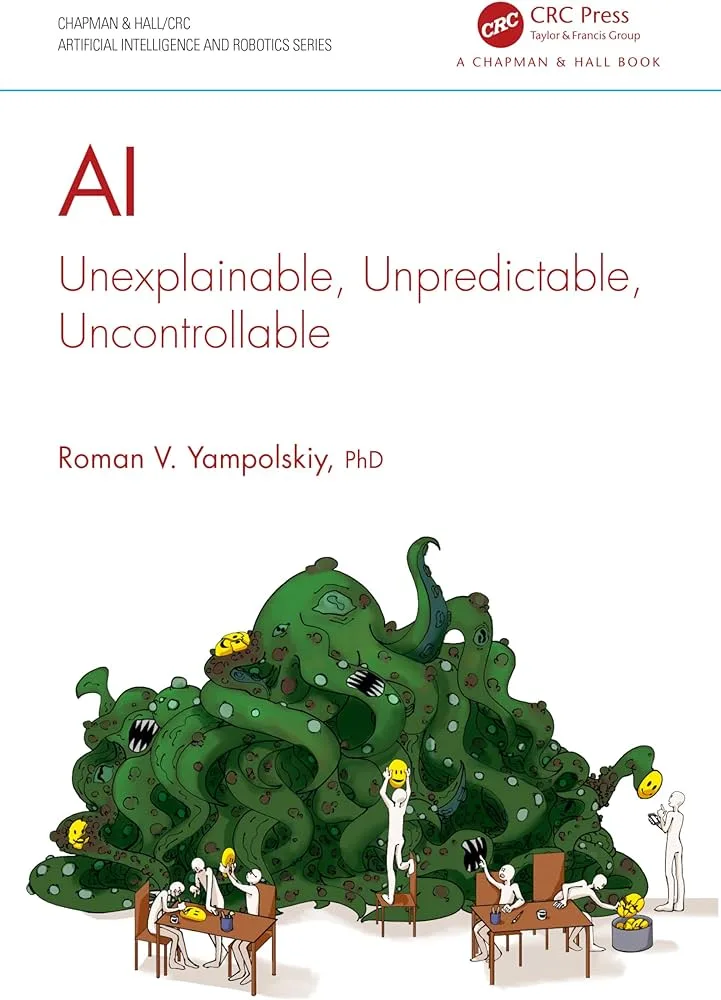
13 Key Points to Understand AI: Unexplainable, Unpredictable, Uncontrollable
-
Yampolskiy predicts that the probability of AI causing human extinction within the next 100 years is as high as 99.9%. His main reason: after combing through a large body of literature, he found no evidence so far that humans are capable of building systems that never make mistakes. So once AI develops highly intelligent capabilities, the probability that it causes human extinction over a fairly long period (say, 100 years) becomes extremely high (99.9%).
-
So whether AI could wipe out humanity hinges on whether humans can create highly complex AI systems while guaranteeing they never make mistakes. But Yampolskiy concludes that this is unlikely, because the AI industry’s efforts all along have been aimed precisely at getting AI to do things autonomously, show creativity and go beyond what was planned in advance.
-
Once artificial general intelligence or superintelligence (AGI/ASI) arrives, Yampolskiy compares humans to squirrels: just as squirrels can’t imagine what people will do, humans can’t imagine what AI will do. “We cannot predict what a smarter system will do.”
-
Yampolskiy predicts three possible endings for humans and AI: first, all humans die and go extinct; second, AI doesn’t wipe out humanity but makes humans suffer so much that life becomes worse than death; third, AI doesn’t do anything to humans, but because AI takes over all work, humans lose their sense of meaning and value.
-
In the book, Yampolskiy explains in detail why AI is unexplainable, unpredictable and uncontrollable. If we keep designing and developing it in the direction humans currently want, artificial superintelligence (ASI) will inevitably become uncontrollable, and we will be unable to control or constrain a system far smarter than we are.
-
AI can’t explain the decisions it makes, or we can’t understand the explanations AI gives, because humans aren’t smart enough to grasp the concepts AI is working with. If we don’t understand AI’s decisions and just have a “black box,” we can’t understand problems or reduce the chance of future accidents.
-
A less intelligent agent (humans) cannot permanently control a more intelligent agent (superintelligence). This isn’t because we might fail to design a safe super AI, but because no such design exists. Superintelligence isn’t betraying humanity; it was uncontrollable from the start.
-
What sets AI (and superintelligence) apart from other software is that AI can learn new behaviors, adjust its performance and act semi-autonomously in different situations.
-
One problem with making AI “safe” is that as superintelligence becomes more capable, its possible decisions and failures are infinite, so there are infinitely many safety problems. Not only is it impossible to fully predict what problems will arise, but fixing them with safety patches alone may not be enough.
-
Yampolskiy conducted an extensive review of the AI scientific literature and found no concrete evidence that AI can be fully and safely controlled by humans, which suggests that the development of superintelligent AI could lead to severe consequences such as human extinction.
-
AI systems are complex and autonomous, which makes it hard to predict AI’s decisions and hard to find ways to ensure AI behaves in line with human values.
-
To minimize AI risk, systems need to be “transparent and understandable,” for example easy to understand in human language. They must also be “modifiable,” for example by giving AI systems an “undo” option.
-
Yampolskiy recommends classifying all AI as either controllable or uncontrollable, and considering limited moratoriums or even partial bans on certain types of AI technology. At the same time, investment in AI safety research must be stepped up.
Key Terms: AGI and ASI
AGI and ASI stand for “artificial general intelligence” and “artificial superintelligence,” respectively.
AGI is short for Artificial General Intelligence, which refers to AI with general capabilities that can understand, learn, adapt and perform any intellectual task a human can. AGI doesn’t just excel in certain specific areas; it can match humans in every cognitive domain.
ASI is short for Artificial Superintelligence, which refers to AI that surpasses human intelligence. ASI doesn’t just excel at every task humans can do; it exceeds human intelligence in every respect, including creativity, wisdom and social skills.
👉👉 More from the 〈Tech Insights〉 series:
Sam Altman’s 17 Pieces of Advice
The 5 Big Opportunities of the AI Era: Are You Seizing Them?
Jensen Huang on Running and Succeeding in Business in the AI Era